
CATL and Kuehne+Nagel agree to work on battery logistics and electric freight
The two companies announced a memorandum of understanding covering battery logistics, electrification of CATL's European transport flows and a Qiji heavy-truck battery-swapping pilot due to launch in China in 2026.
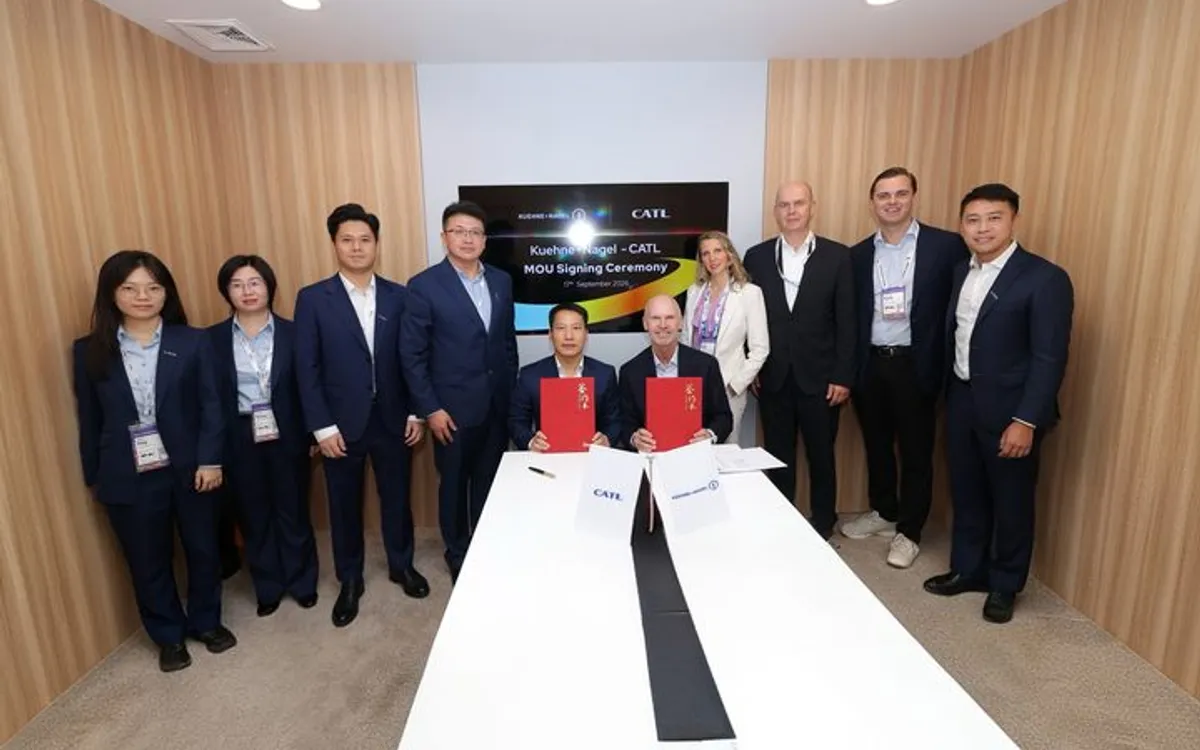
Swiss freight forwarder Kuehne+Nagel announced on September 18 that it had signed a memorandum of understanding with Chinese battery maker CATL on battery logistics and transport electrification. The partners said the partnership would initially target electrification of CATL's transport flows in Europe and a battery-swapping pilot for heavy-duty trucks run by Qiji, scheduled to launch in China in 2026.
The initial scope is narrow and operational rather than a commercial supply contract. Electrifying CATL's own European freight lanes puts the battery maker in the customer role, while the Qiji pilot tests heavy-truck operations using battery swaps. Kuehne+Nagel described the agreement as a partnership involving its Road Logistics business. The group also identified energy storage and charging at logistics facilities as areas for potential cooperation. CATL named both workstreams as starting points; recycling, aftersales, and storage and charging at logistics sites are listed as additional areas without described commitments.
The memorandum also frames emissions accounting. CATL said the activities support both companies' Scope 3 reduction ambitions across their logistics and transportation value chains, meaning emissions generated by contracted freight and upstream battery movements rather than their own plants. Neither company disclosed a volume target, investment figure or number of vehicles covered by the arrangements described in the announcement.
The forwarder described the agreement as an extension of a relationship covering batteries and related logistics. The September release identifies practical workstreams, but it does not specify which European routes would be converted first, where trucks would recharge or how individual transport contracts would be awarded.
The two initial projects have different infrastructure requirements. A truck using a swapping service needs a compatible battery pack and a site on its route. Electrifying existing European transport flows may involve different equipment depending on the routes, carriers and vehicle types selected. The memorandum left those operating details open.
On 14 November 2026, CATL said it had 2,520 battery-swap stations across 200 Chinese cities as of the end of September 2026, integrating swapping with fast charging and vehicle-to-grid interaction. That figure describes CATL's existing Chinese network, not the Qiji heavy-truck pilot, and the September document did not say whether the truck programme would use those stations or separate sites.