
IIHS finds uneven automatic braking in cargo vans and Class 3 pickups
The first IIHS front crash prevention ratings for cargo vans and Class 3 pickups put the Sprinter 2500 first for vehicle targets and the BrightDrop 400 and Rivian RCV-Delivery 500 first for pedestrians.
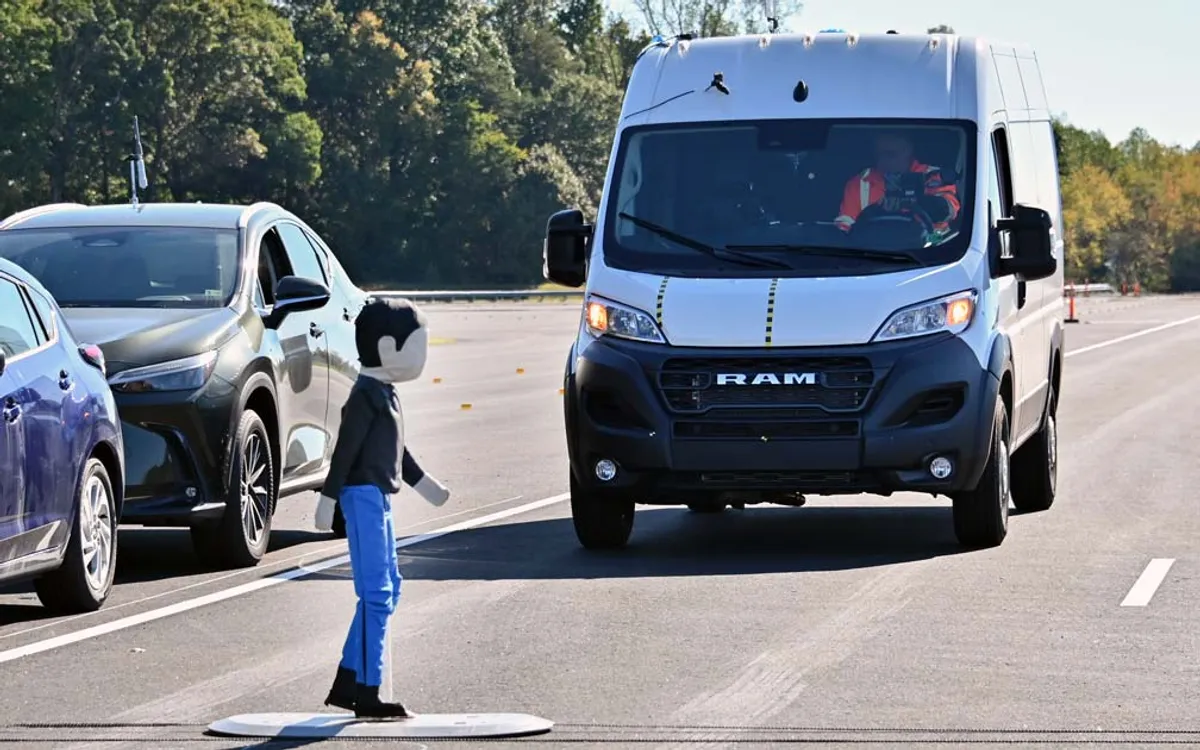
Cargo vans earned the top ratings in the first front crash prevention tests the Insurance Institute for Highway Safety released for cargo vans and Class 3 pickups on October 8. The Mercedes-Benz Sprinter 2500 was the only vehicle in the group to earn a good rating for avoiding collisions with other vehicles. The Chevrolet BrightDrop 400 and Rivian RCV-Delivery 500 earned good ratings in pedestrian tests. The results give US fleet buyers two ways to compare the same models, depending on whether their vehicles spend more time around pedestrians or moving through traffic.
The Sprinter earned an acceptable pedestrian rating. The BrightDrop earned acceptable in the vehicle-to-vehicle evaluation, while the Rivian was marginal in that category. Ford’s F-350 and the Ram 3500 were the only pickups rated acceptable for pedestrian crash prevention, and their vehicle-to-vehicle ratings were poor and marginal, respectively. The Chevrolet Express 2500 and GMC Savana 2500 scored poor in both evaluations. IIHS says they lack automatic emergency braking and offered forward collision warning as an option.
The tests examine different behaviour. In the vehicle evaluation, IIHS checks warning and automatic emergency braking at different speeds with passenger car and motorcycle targets. It also checks whether a vehicle warns the driver when approaching a semitrailer. Motorcycles presented the biggest difficulty: some vehicles hardly ever warned or slowed, while others braked but gave the driver too little warning to score well. A vehicle can therefore have an automatic braking system and still perform poorly in particular situations.
The pedestrian evaluation includes adult or child targets crossing the road and an adult walking in the travel lane. IIHS reported that some vehicles struggled more with the child target during the day than with the adult target at night. It pointed to a possible interaction between the short target, tall vehicle fronts and sensors near the rearview mirror. Low-beam and high-beam runs also exposed differences in some systems’ nighttime performance.
The October ratings add to the driver-protection assessments IIHS started publishing in June. Its front crash protocols use the same requirements as the institute’s passenger-vehicle tests. The initial pickup ratings cover Class 3 vehicles, which have a gross vehicle weight rating of 10,001 to 14,000 pounds, including the vehicle and its load. For fleet specifications, the model and model year in the ratings table matter as much as the presence of a feature on an equipment list. IIHS plans to add headlight and rear automatic braking ratings and later expand testing to larger trucks.