
Hyundai Motor unveils hydrogen charging robot and 5 MW electrolyser module in Goyang
Hyundai Motor Group showed a proof-of-concept automatic hydrogen charging robot and a 5 MW PEM electrolyser stack module at World Hydrogen Expo 2026, aiming for charging outside staffed station hours and modular hydrogen output.
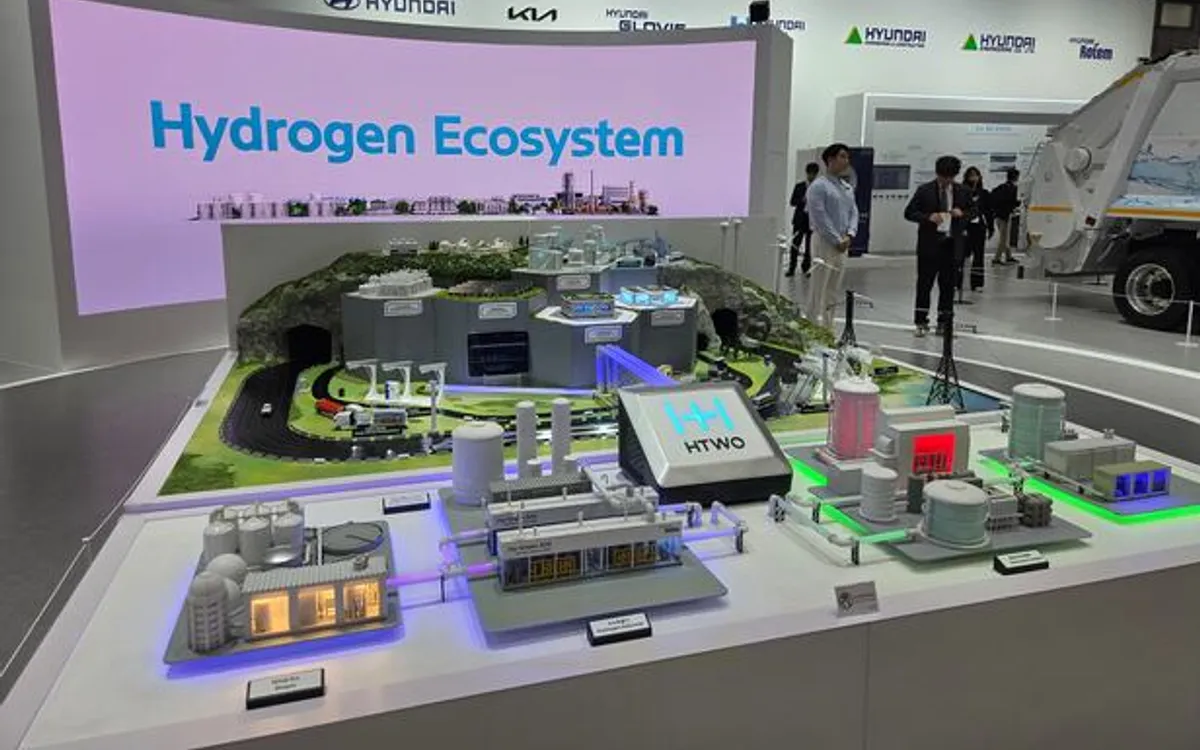
Hyundai Motor Group on 4 November unveiled an automatic hydrogen charging robot, ACR-H, and a 5 MW polymer electrolyte membrane electrolyser stack module at World Hydrogen Expo 2026 in Goyang, Gyeonggi Province. The robot is at proof-of-concept stage, with development under way for commercialisation; the company's stated goal is to apply automatic charging at working hydrogen stations and, longer term, to enable unmanned 24-hour charging.
The practical constraint today is station hours. A Hyundai Motor official said charging is possible only during hours when a safety manager is present, and that robot charging combined with an advanced safety management system would allow refuelling regardless of time, in snow or rain. For bus and truck fleets, that means operating schedules currently set to station business hours could shift to overnight refuelling while vehicles are parked, letting them leave in the morning without a charging wait.
Hyundai Motor had sold a cumulative 50,262 hydrogen electric vehicles in Korea as of the end of September. The group also exhibited for the first time a fuel cell system for commercial vehicles, which it says has enhanced durability. Buses and trucks run longer and carry heavier loads than passenger cars, so a longer replacement cycle cuts maintenance time and cost for operators.
The electrolyser module bundles 12 stacks into one 5 MW unit. Hyundai says one module produces about 700 tons of hydrogen a year, and that lining up modules like building blocks yields plants of hundreds of megawatts, allowing capacity to be added as demand grows. The group operates a 1 MW container-type demonstration facility in Gwangju and is pursuing demonstrations in Boryung, Buan and Jeju.
Ivana Jemelkova, CEO of the Hydrogen Council, said at the show that Korea's hydrogen industry is "a 100% role model, with an ecosystem where supply and demand are well connected." She said China is ahead in electrolysis investment aligned with government strategy and India is focusing on hydrogen to move from importer to exporter, adding that Korea should build on its hydrogen mobility market. Hyundai Motor Group vice chairman Chang Jae-hoon has served as the council's co-chair for the past two years.
The announcements remain plans and demonstrations rather than completed deployments: the charging robot is pre-commercial, and the 5 MW module was shown as a first exhibit. The near-term effect falls on Korean hydrogen station operators and on bus and truck fleets whose refuelling windows are tied to staffed hours; the production-side effect depends on scaling demonstrations beyond the existing 1 MW facility.