
China’s dealer inventory coefficient rises to 1.68 in September
CADA's September 2026 survey put the composite dealer inventory coefficient at 1.68, up 6.3% on August and 24.4% on September 2025, with estimated channel stocks of about 2.7 million vehicles at month end.
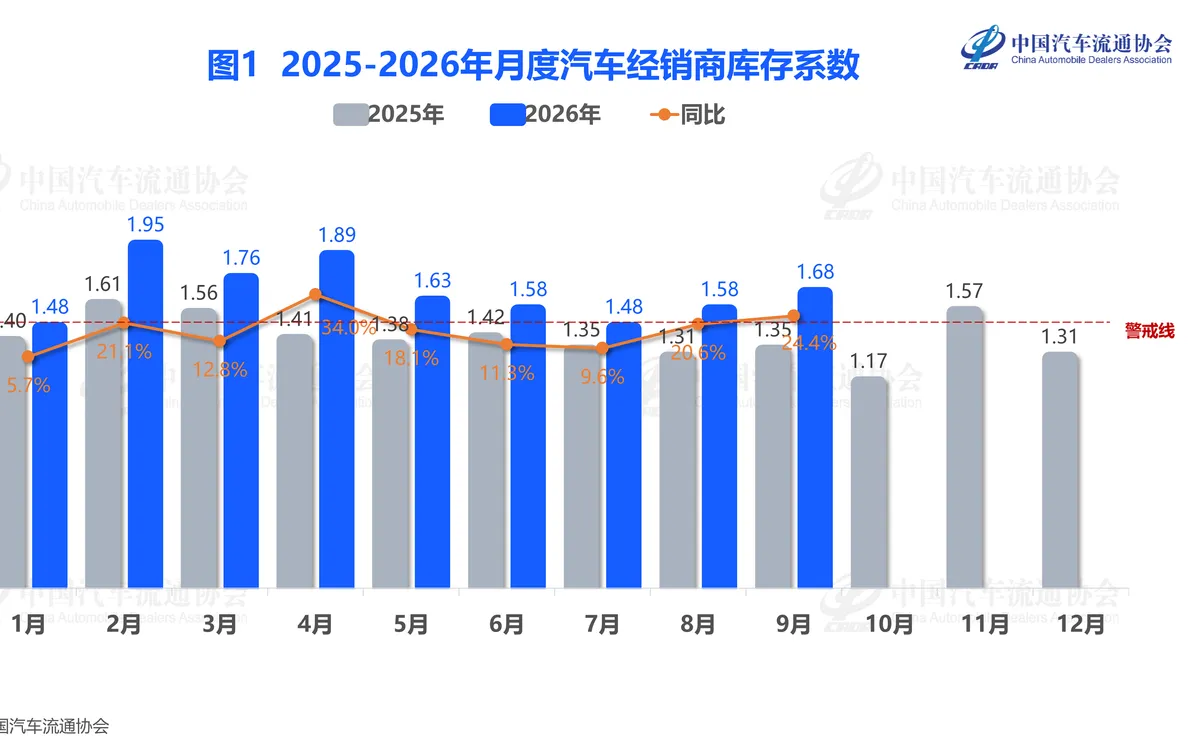
The China Automobile Dealers Association reported on October 13, 2026, that its September dealer inventory coefficient was 1.68, up 6.3% from August and 24.4% from September 2025. CADA calculates the coefficient as period-end inventory divided by sales for the period. A reading above 1.5 marks a warning level under the association's convention, and above 2.0 indicates excessive stock with high operating pressure.
CADA estimated that dealers held about 2.7 million vehicles at the end of September. It also cited the China Passenger Car Association’s nationwide passenger-vehicle retail tally of 1.618 million for the month. The association described the September market as a weaker-than-usual peak season, citing cautious consumers waiting for holiday auto shows or year-end promotions.
Brand groups moved in opposite directions. The premium, luxury and imported segment posted a coefficient of 1.54, down 20.2% month on month. Joint-venture brands reached 1.90, up 9.8%, and domestic brands 1.60, up 10.3%. CADA listed nine mainstream brands with inventory depth above two months, ordered from highest: Dongfeng Honda, GAC Honda, XPeng, Dongfeng Yipai, FAW Hongqi, FAW-Volkswagen, Dongfeng Nissan, Jaguar Land Rover and Bestune.
The survey covers primarily the annual top 100 Chinese dealer groups, spanning more than a thousand 4S stores across most provinces and 55 vehicle brands. CADA has run the inventory survey since July 2010. The coefficient basis is period-end stock over current-period sales, so a slow sales month lifts the ratio even when absolute stocks are flat; the comparison with August and September 2025 therefore reflects both stock and demand.
For October, CADA expects passenger-vehicle sales to rise slightly from September in a pattern of a holiday peak followed by a post-holiday decline. It cited the National Day holiday and auto shows, plus local consumption subsidies in Henan, Tianjin, Nanjing and Xining, as supports. The association advised dealers to estimate demand rationally and control inventory levels, while promoting trade-in and scrappage-update policies and prioritising cost reduction.
On the supply side, CADA said automakers began year-end volume pushes in September, with dense new-model launches across price segments and limited-time terminal discounts combined with local subsidies. It said footfall and orders improved from the third week of September, yet retail sales remained under pressure and dealer inventory kept climbing. The resulting coefficient sits above the warning threshold, though below the 2.0 level the association associates with high risk.