
BMW i3 50 xDrive crosses Europe with 2h 46m of charging on 5,886.7 km run
BMW said its new i3 50 xDrive drove from the North Cape to Tarifa, 5,886.7 km, with 2 hours 45 minutes 54 seconds of DC charging, beating the 2017 Paneuropeana record by more than seven hours. The car averaged 12.5 kWh/100 km, below its 18-13.4 kWh/100 km WLTP combined figure.
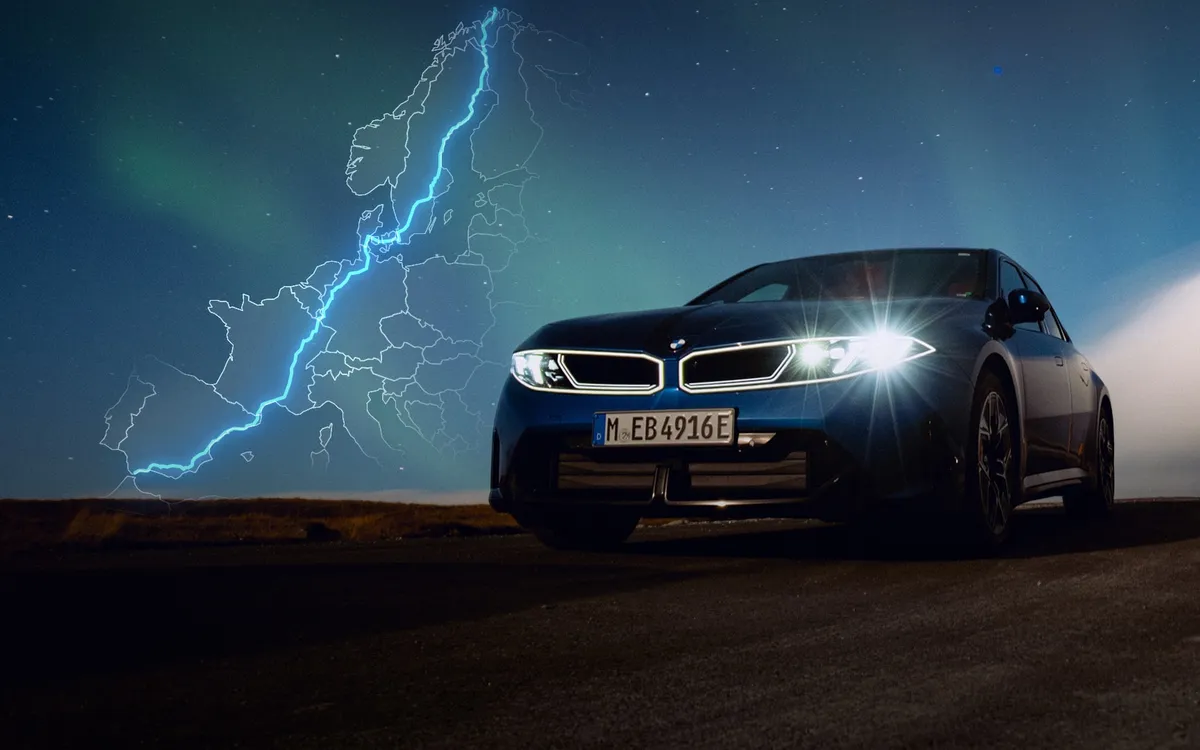
BMW Group said on 10 November that a new BMW i3 50 xDrive covered 5,886.7 km from the North Cape in Norway to Tarifa in Spain with 2 hours 45 minutes 54 seconds of DC charging, rounded to 2 hours 46 minutes. The company said the run beat the previous Paneuropeana record from 2017 by more than seven hours. The Paneuropeana route is run to checkpoints, and the winner is decided on total charging time, not road speed.
The event is a record attempt, not a customer deliverable, and BMW supplied the vehicle. The company said the i3 was hardware- and software-identical to series production specification and charged only at publicly accessible points in each national network. It crossed eight countries on motorways, country roads and through towns. Driving time was 3 days, 2 hours and 41 minutes at an average of 79.7 km/h. Charging averaged 275 kW against a peak DC rating of up to 400 kW.
Energy consumption averaged 12.5 kWh/100 km. That is below the i3 50 xDrive's WLTP combined figure of 18-13.4 kWh/100 km, so the run does not represent a typical WLTP cycle. BMW attributed the result to the Gen6 eDrive package, including a drag coefficient of 0.21, 19-inch aerodynamic wheels and tyres with rolling resistance 14% better than the 'A' label requires. Recuperation, managed by the 'Heart of Joy' computer, covers more than 95% of braking, the company said.
The i3 50 xDrive has one motor per axle, 345 kW/469 PS and 645 Nm, and accelerates to 100 km/h in 4.7 seconds. A 108.7 kWh usable lithium-ion cylindrical battery gives up to 912 km WLTP range, and BMW claims 423 km WLTP of range can be added in 10 minutes at a DC charger. BMW said Gen6 motor losses are 40% lower than Gen5, and cylindrical cell volumetric energy density is 20% higher than Gen5 prismatic cells.
A single BMW engineer drove throughout, with an identical i3 and an iX3 50 xDrive as support vehicles. That matters for how the figures should be read: one driver, planned charging stops and support vehicles can reduce downtime. The charging points were not fixed in advance, so the team chose stops between checkpoints based on the charging infrastructure, weather and traffic, BMW said.
The record depends on both the car and the charging network. Maximum charging power of up to 400 kW is only usable where chargers can deliver it. BMW did not disclose the number of charging stops, the state of charge at each stop or the share of time spent at lower power. Those gaps limit how far the 275 kW average can be generalised to other corridors or to fleets without route planning.
The i3 is the first fully electric 3 Series based on the Neue Klasse and is due in 2026. It will be built at BMW Group Plant Munich, which the company said has been modernised with a new body shop and assembly facility. For fleet operators, the headline is that charging time, not driving time, decided the result. The test was run with production-spec software and hardware, BMW said.