
XPeng details a research model for visual perception in vehicles and robots
Researchers linked to XPeng, Peking University and the University of Hong Kong published GroundingPI, a roughly 4-billion-parameter visual perception model, with a research paper, code and weights available; the 0.296-metre trajectory error comes from an offline nuScenes evaluation, not a vehicle deployment.
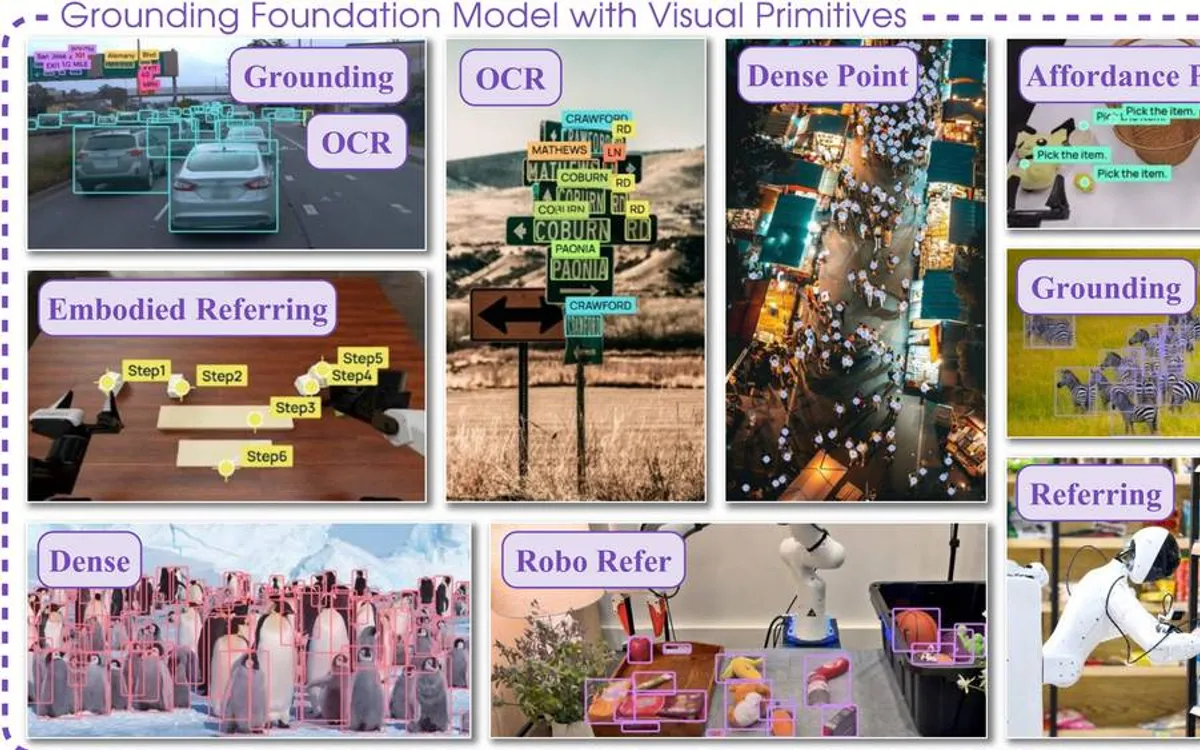
Researchers affiliated with XPeng, Peking University, The University of Hong Kong and other institutions developed GroundingPI, an open-source visual perception model of about 4 billion parameters. The research paper appeared on arXiv on September 30 and XPeng announced the work on November 4, pointing to the paper, code and model weights. The work targets physical AI, the use of models in robots and vehicles rather than in text-only settings. Guangzhou-based XPeng disclosed the release.
The design choice separates perception from action. GroundingPI is trained without robot action labels, focusing instead on visual understanding that downstream action-learning systems can use. It represents spatial information as coordinates, points and bounding boxes, so a request such as the handle of the cup on the right yields the handle position, not just the cup. Training covers 11 perception categories, including object detection, dense localisation, referring-expression grounding, optical character recognition and document layout.
In the team's evaluation, GroundingPI averaged 73.68 across 34 perception benchmarks, against 71.54 for GPT-6 Astra. The underlying paper also cites an average open-loop trajectory prediction error of 0.296 metres when the model served as a visual backbone in an autonomous-driving perception evaluation on the nuScenes dataset. That figure comes from an offline research test; the release gives no confirmation that GroundingPI is deployed in a production vehicle.
Simulation results cited by the team point to improved robotic manipulation and training-data efficiency, with adaptability across environments described as a goal of the perception-first approach. These are research findings rather than validated fleet outcomes. The release does not name vehicle programmes, plant locations or production timelines tied to the model, and it does not specify which versions of the benchmarks were run beyond the counts stated.
XPeng said the team tested the two models on the same 34 benchmarks and weighted the 11 capability categories equally. The comparison concerns perception scores for a general-purpose model and a specialised one. It gives no comparative driving-system performance. The 0.296-metre error is not comparable to on-road disengagement or intervention metrics, because open-loop trajectory prediction replays recorded data and does not close the control loop. Units are metres, and the dataset is nuScenes.
XPeng framed the release as a contribution to open research in physical AI, and the public availability of code and weights lets outside groups reproduce or extend the evaluation. The practical distinction for industry readers is between a published perception backbone and a shipped driver-assistance feature: the former supports benchmarking and downstream training, while the latter requires validation that the research does not report. No commercial deployment date was provided.