
Mazda adds solar contracts for its Hiroshima logistics and testing sites
ORIX will supply Mazda’s Dejima and Miyoshi sites. A steel supplier will acquire the renewable attributes from surplus Dejima generation.
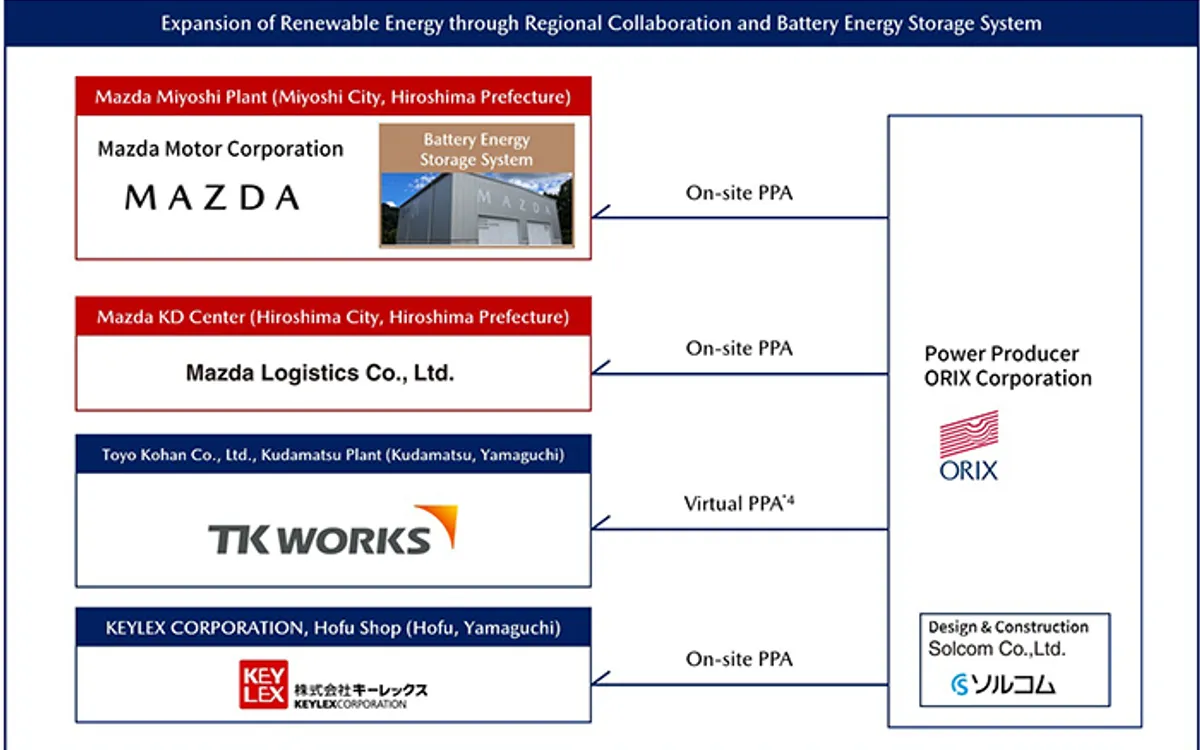
Mazda and ORIX announced agreements on October 30 to supply on-site solar power to Mazda's new Hiroshima parts logistics centre and its Miyoshi operations. The two sites will handle excess generation differently. Miyoshi will use battery storage to move some of its solar power into periods of higher demand. At the logistics centre, the environmental attributes of surplus power will go to Toyo Kohan, a steel sheet manufacturer that supplies Mazda.
At the Dejima logistics centre, ORIX rated the rooftop equipment at 2.2 megawatts and estimated production of 2.6 gigawatt-hours in its first year. It set a November start for power supply to Mazda and Mazda Logistics, which use the same site. ORIX expects around 77% of the electricity to be used at the centre. Toyo Kohan says it will acquire the environmental attributes associated with the remaining roughly 23% for its Kudamatsu operation in Yamaguchi Prefecture.
That arrangement separates the electricity from its renewable attributes. Through an on-site power purchase agreement, ORIX supplies the physical electricity used at the Hiroshima logistics centre. A virtual agreement gives Toyo Kohan the attributes associated with generation beyond the centre's expected requirements. The percentages describe ORIX's estimated distribution of first-year generation. The share will depend on production and consumption once the facility is operating.
At Mazda's Miyoshi Plant and Miyoshi Safety Testing Laboratory 3, the solar installation is rated at 0.8 megawatts and expected to supply 0.9 gigawatt-hours in its first year. The planned power supply start is December. Mazda says the site will store surplus output in a stationary battery system made with new automotive lithium-ion batteries. The objective is to use more of the power generated on-site and draw less electricity during peak demand. The announcement gives no storage capacity or target for peak demand reduction.
The agreement also extends to supplier Keylex. ORIX expects an additional 0.8-megawatt rooftop installation to begin supplying the component maker's Hofu shop in Yamaguchi in June 2027, with estimated first-year generation of 0.9 gigawatt-hours. Mazda has set a 2035 carbon-neutrality goal for its global manufacturing facilities. The contracts show how one regional programme reaches the automaker's own sites and two suppliers. At Miyoshi, the measure to watch is how much energy can be carried into peak hours, while the Dejima arrangement depends on the actual surplus available for the virtual contract.
Sources
- Mazda Motor Corporation
- ORIX · project terms and first-year generation estimates
- Toyo Seikan Group Holdings · Toyo Kohan contract