
China's automotive manufacturing investment falls 7.9% through October
Automotive investment contracted faster than overall manufacturing and the decline deepened from 6.3% through September. Fixed-asset spending is measured separately from production and operating results.
Fixed-asset investment in China's automobile manufacturing industry fell 7.9% year over year from January through October 2026, the National Bureau of Statistics reported on November 16. The decline deepened from 6.3% through September. Manufacturing investment overall fell 2.9% through October, placing the automotive industry's drop five percentage points below the broader manufacturing rate.
The bureau tracks completed construction and purchases of fixed assets, along with associated expenses. Its industry table reports a nominal year-over-year growth rate for automobile manufacturing, without an absolute spending total for that industry. The 7.9% compares the first ten months with the same period a year earlier. Subtracting the two year-to-date rates gives a 1.6-point change in their growth gap and cannot establish the volume or rate of October investment on its own.
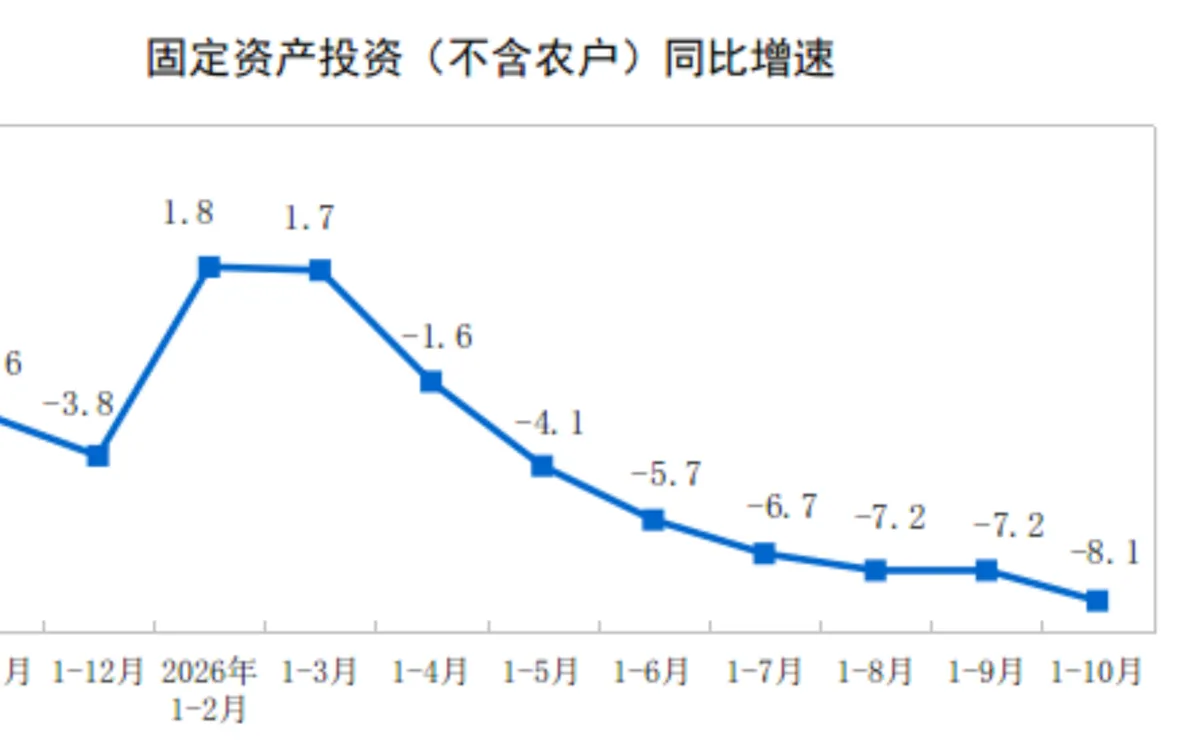
The contraction also needs a national comparison. Total fixed-asset investment excluding rural households was RMB 36.4824 trillion across the ten months, down 8.1% on a comparable basis. Investment in railway, shipbuilding, aerospace and other transport equipment manufacturing rose 14.1%. The latter is a separate industrial category. The same table shows a 1.2% decline in general-purpose equipment manufacturing and a 9.0% decline in special-purpose equipment manufacturing. Those rows describe equipment manufacturers’ own investment. The bureau classified each series by the industry making the investment.
The sector's income data provides a different look at its finances. In its report on industrial profits through September, the bureau put auto manufacturing operating revenue at RMB 8.04352 trillion, up 2.6% year over year. Total profit fell 22.8% to RMB 267.54 billion. That profit report covers industrial enterprises above designated size, so the revenue and profit figures cannot be used to calculate an industry investment ratio from the fixed-asset release.
Output also moved differently across products. The bureau's October production release showed new-energy vehicle output up 12.7% over ten months while total vehicle output fell 4.1%. A component supplier can therefore face two separate questions when planning a new line. One is how many vehicles its current customers are building and which powertrains are gaining a larger share. The other is which manufacturers are still carrying out planned plant, equipment or tooling purchases. The national investment figures show a contraction in completed investment. An individual supplier needs the customer's order book or announced project schedule to connect that contraction to its own capacity plans.
Sources
- National Bureau of Statistics of China · 2026-11-16
- National Bureau of Statistics of China · 2026-10-19
- National Bureau of Statistics of China · 2026-10-27
- National Bureau of Statistics of China · 2026-11-16