
Toyota launches upgraded Sora fuel cell route bus co-developed with Isuzu
Toyota began sales of the new Sora fuel cell route bus on 5 October 2026, built on Isuzu's flat-floor bus platform with Toyota's FC system. Toyota says tank capacity fell about 20% while range rose about 100 km to more than 300 km, measured under its own reference conditions.
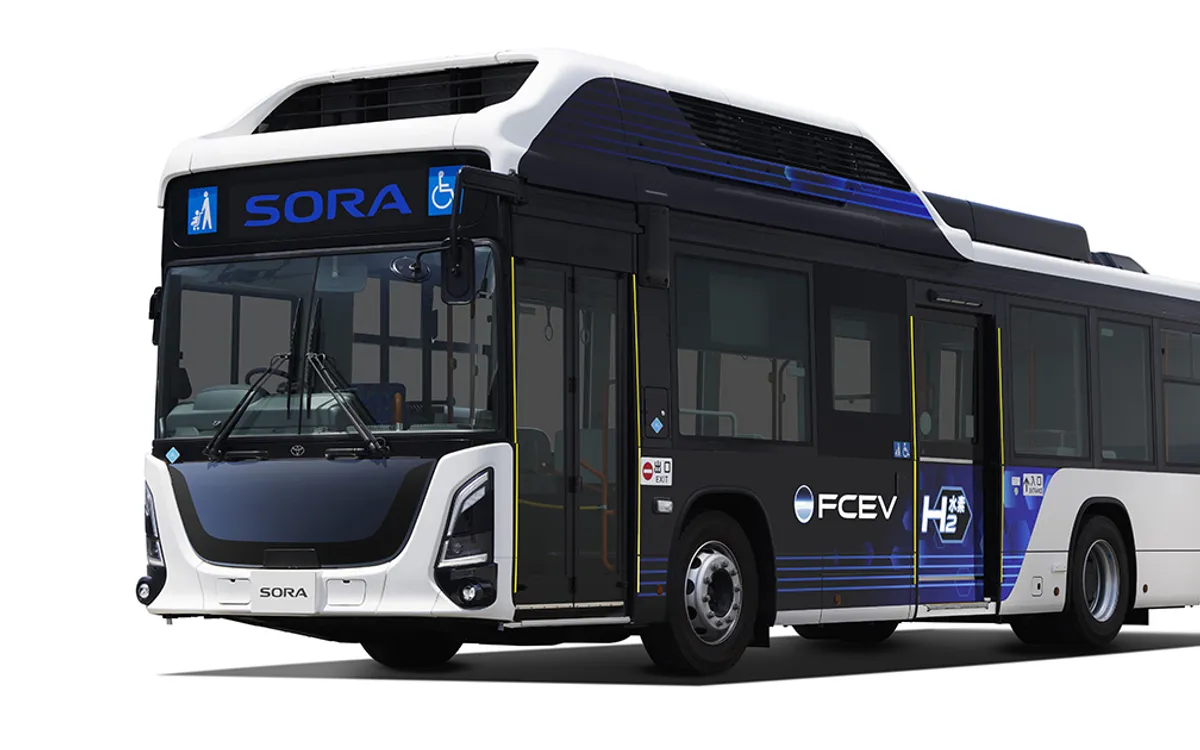
Toyota Motor began offering the upgraded Sora fuel cell route bus on 5 October 2026, a vehicle jointly developed with Isuzu Motors and the first public output of a fuel cell route bus collaboration the two companies disclosed on 29 September 2025. The bus pairs Isuzu's battery-electric full-flat floor route bus platform with Toyota's fuel cell system. Toyota did not disclose output, pricing or the markets where it will sell the model.
The drivetrain change is the substance. Toyota says total hydrogen tank capacity is about 20% smaller than on the first-generation Sora launched in 2018, while cruising range is about 100 km longer at more than 300 km. Toyota labels both figures as reference values from its own measurements; actual figures vary with temperature, traffic, passenger load and air conditioning. The urban model carries three 70 MPa tanks with 471 L total volume.
Specifications for the urban model list a polymer electrolyte membrane Toyota FC stack rated at 113 kW and two AC induction motors producing 220 kW combined and 970 N·m. Capacity is 70 people, comprising 19 seated, 50 standing and one crew member. Overall dimensions are 10,545 mm long, 2,485 mm wide and 3,440 mm high. Four variants are offered, two for urban use and two for suburban use, with different seat layouts.
Toyota says the redesigned stack for commercial vehicles has higher output and durability, and that a new large-capacity hydrogen tank for commercial use was developed. Mounting the FC system compactly on the roof is intended to make maintenance easier for bus operators. Toyota says a full refuel takes about 10 minutes under its own reference measurements, which vary with station capacity and ambient temperature, and that the vehicle complies with a new high-speed filling standard; refuelling time could be about halved once compatible hydrogen stations are deployed.
Safety equipment includes an Emergency Driver Stop System linked to a Driver Status Monitor. Toyota says that if the system detects a problem with the driver, the vehicle decelerates, stops, automatically applies the parking brake and remains secure on slopes. A front blind spot monitor detects pedestrians and bicycles ahead and alerts the driver. The cabin has a step-free full-flat floor; a one-touch wheelchair securement system is optional and will be orderable from around April 2027.
Toyota says it has supplied more than 3,500 fuel cell systems to over 100 customers worldwide for buses, rail and stationary generators as of the end of September 2026. The Sora is a route bus, not a passenger car, so it competes in the municipal and private transit procurement segment rather than retail channels. Operators choosing it depend on hydrogen station availability, and the promised halving of refuelling time depends on stations that meet the new standard.
What remains undisclosed is volume: Toyota gave no production target, no price per unit and no named customers or transit operators for the new model. Those gaps matter to fleet buyers assessing total cost against battery-electric route buses, where Isuzu's own platform already competes. The vehicle can also supply external power through an external power supply unit for use as an emergency source during disasters, Toyota says, a function aimed at municipal operators.