
Nissan details the Frontier plug-in hybrid’s low-range 4WD for Mexico
Nissan’s Mexican Frontier PRO PHEV pairs a turbo petrol engine and hybrid transmission with a transfer case and locking rear differential. The company says it validated the setup over more than 100,000 km for the region.
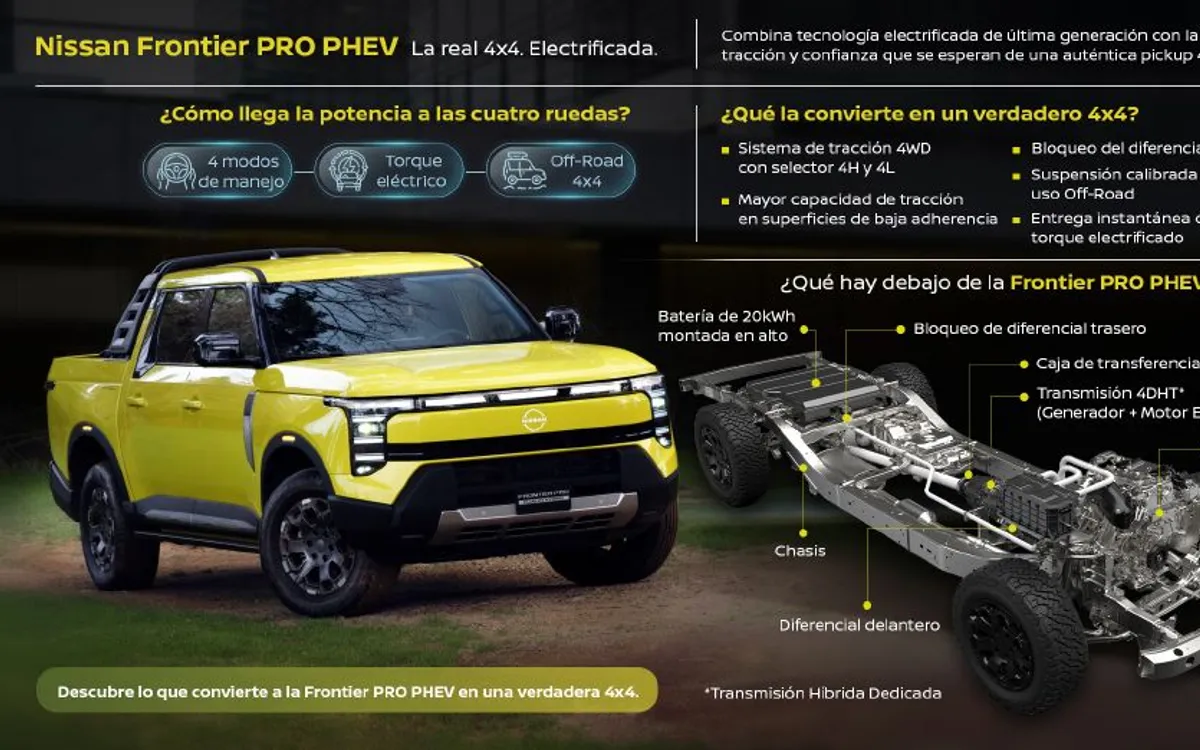
Nissan detailed the four-wheel-drive system in the Mexican-market Frontier PRO plug-in hybrid on November 12, a month after unveiling the pickup in Mexico. The truck uses a transfer case with high and low range and a locking rear differential. Nissan retained hardware for low-speed off-road work as it added a battery, an electric motor and a dedicated hybrid transmission to the Frontier lineup.
The hybrid driveline combines a 1.5-litre turbocharged gasoline engine with a four-speed transmission that incorporates an electric motor and a generator. When four-wheel drive is engaged, the transfer case distributes power between the front and rear axles. Nissan describes 4HI as the setting for lower-grip surfaces and 4LO as the setting for harder obstacles or grades at low speeds. The rear differential lock couples the two rear wheels when engaged, so one losing traction does not prevent the other from helping move the truck.
Nissan said its engineering teams covered more than 100,000 km of validation and tuning for Mexico and Latin America. Testing included sand, mud, gradients and uneven roads. The work informed the final configuration for the region, the company said. That figure refers to the manufacturer’s development programme, with no independent performance or fleet durability results in the release.
The October launch release gives buyers the comparison point for the November engineering disclosure. Nissan listed two Mexican versions, the LE at MXN 899,900 and the Platinum from MXN 969,900. Its specification for the LE included 350 hp, 660 Nm of torque and a 20 kWh battery. Nissan rated the truck to tow up to 3.5 tonnes and carry up to 815 kg. The Platinum adds, among other equipment, a towing kit and powered side steps.
The transfer case and rear differential lock matter for buyers who need to move equipment or work on low-grip surfaces. The October specifications set out the stated carrying and towing limits, and the November release explains which mechanical equipment the driver can use once off the road. The two sources give distinct information for that assessment. The latest release does not compare real-world range or energy consumption under towing loads, so a fleet cannot use the headline capability figures to estimate fuel or electricity costs on its own routes.