
Battery-electric sales edge past petrol in Australia again
Battery-electric cars accounted for 24.9% of the September 2026 market, just ahead of petrol-only cars at 24.7%, the Electric Vehicle Council said.
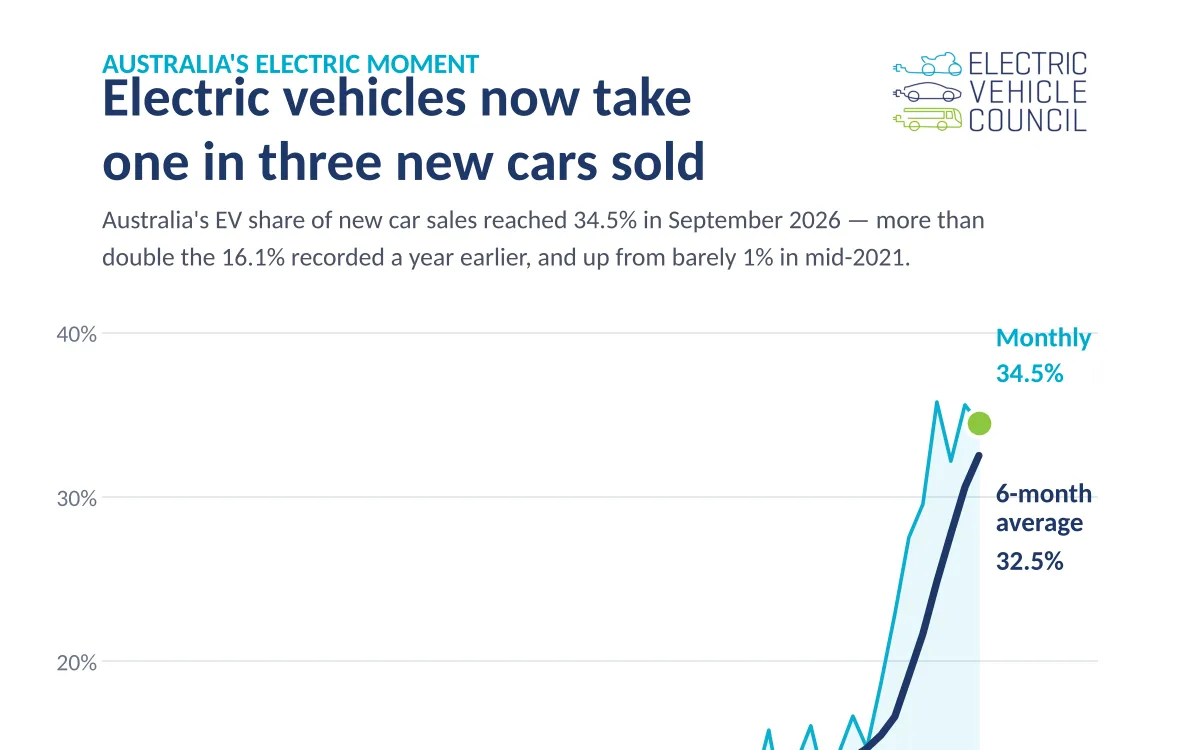
Australian buyers took delivery of 26,287 new battery-electric vehicles in September 2026, slightly more than the number of petrol-only vehicles sold, the Electric Vehicle Council said on October 8. Battery electrics took 24.9% of the new-car market and petrol-only cars 24.7%, making September the second consecutive month that battery electrics led the two fuel categories.
Plug-in hybrids supplied another 10,072 vehicles, the difference between the council’s battery-electric tally and its total of 36,359 new plug-in vehicles. Together the two categories accounted for 34.5% of the market. That is below the 36% the council reported for August, while the six-month rolling average rose to 32.5% from August’s 30.6%. The monthly share and the rolling measure moved in different directions as September replaced an earlier month in the six-month calculation. In July the council had recorded 33,869 new plug-in vehicles and a combined share of 32.2%. July’s battery-electric tally alone was 23,510. By September, plug-ins made up a larger monthly share than in July even after falling back from August.
The year-on-year comparison was larger. The combined plug-in share was 16.1% in September 2025, and the council reported 119% growth in combined sales over the following year. The overall new-car market grew 2.3%. Petrol sales fell 36.2% from a year earlier and diesel sales fell 18.4%, according to the September compilation. The combined share measures vehicles that can connect to an external power supply. It excludes hybrids that cannot be plugged in.
The battery-electric share stayed at August’s rounded 24.9%, even as the overall battery-electric count fell from the 27,089 the Federal Chamber of Automotive Industries cited across reporting sources for August. The council reports Tesla and Polestar sales, while the chamber publishes sales from its VFACTS contributors, as the council explained in a 2025 submission to the Australian Energy Market Operator. The chamber’s September release put the battery-electric share from all sources at 24.2%, compared with the council’s 24.9%. Both organizations publish their own monthly analysis. The council’s September headline uses its own compilation to compare battery-electric and petrol sales, while the chamber’s release did not give the denominator for the council’s calculation.
Deliveries can move from one month to the next as shipments arrive, council chief executive Julie Delvecchio said. For retailers and charging operators, the six-month measure shows what remained after that monthly timing effect was spread across several months. In September the two plug-in categories together represented slightly more than one in three new-car sales, while battery-electrics alone led petrol by only two tenths of a percentage point.
Sources
- Electric Vehicle Council
- Electric Vehicle Council August survey of the new-vehicle market
- FCAI August VFACTS release with all-sources battery-electric count
- Electric Vehicle Council submission on vehicle sales data coverage
- Electric Vehicle Council July new-vehicle market results
- FCAI September sales release and all-sources battery-electric share